全部知识点
#include <iostream>
using namespace std;

int fun(int n, int minNum, int maxNum) {
    int tot, i;
    if(n == 0)
        return 1;
    tot = 0;
    for (i = minNum; i <= maxNum; i++){
        tot += fun(n - 1, i + 1, maxNum);
    }
    return tot;
}

int main(){
    int n,m;
    cin >> n >> m;
    cout << fun(m, 1, n) << endl;
    return 0;
}
输入:
6 3
输出:( )
#include <iostream>
#include <string>
using namespace std;
const int SIZE = 100;

int main(){
    string dict[SIZE];
    int rank[SIZE];
    int ind[SIZE];
    int i, j, n, tmp;
    cin >> n;
    for (i = 1; i <= n; i++){
        rank[i] = i;
        ind[i] = i;
        cin >> dict[i];
    }
    for(i = 1; i < n; i++){
        for(j = 1; j <= n - i; j++){
            if(dict[ind[j]] > dict[ind[j + 1]]){
                tmp = ind[j];
                ind[j] = ind[j + 1];
                ind[j + 1] = tmp;
            }
        }
    }
    for(i = 1; i <= n; i++)
        rank[ind[i]] = i;
    for(i = 1; i <= n; i++)
        cout << rank[i] << " ";

    cout << endl;
    return 0;
}
输入:
7
aaa
aba
bbb
aaa
aaa
ccc
aa
输出:( )
#include <iostream>
using namespace std;

const int SIZE = 100;

int alive[SIZE];
int n;

int next(int num){
    do {
        num++;
        if (num > n)
            num = 1;
    } while(alive[num] == 0);
    return num;
}

int main() {
    int m, i, j, num;
    cin >> n >> m;
    for (i = 1; i <= n; i++)
        alive[i] = 1;
    num = 1;
    for (i = 1; i <= n; i++){
        for(j = 1; j < m; j++)
            num = next(num);
        cout << num << " ";
        alive[num] = 0;
        if (i < n)
            num = next(num);
    }
    cout << endl;
    return 0;
}
输入:
11 3
输出:( )
(双栈模拟数组) 只使用两个栈结构 stack1 和 stack2,模拟对数组的随机读取。作为栈 结构, stack1 和 stack2 只能访问栈顶 (最后一个有效元素) 。栈顶指针 top1 和 top2 均指向栈 顶元素的下一个位置。 输入第一行包含的两个整数,分别是数组长度 n 和访问次数 m,中间用单个空格隔开。 第二行包含 n 个整数,一次歌出数组各项(数组下标从 0 到 a-1)。第三行包含 m 个整数, 需要访问的数组下标。对于每次访问,输出对应的数组元素。
#include <iostream>
using namespace std;

const int SIZE = 100;

int stack1[SIZE], stack2[SIZE];
int top1, top2;
int n, m, i, j;

void clearStack(){
    int i;
    for(i = top1; i < SIZE; i++)
        stack1[i] = 0;
    for(i = top2; i < SIZE; i++)
        stack2[i] = 0;
}

int main(){
    cin >> n >>m;
    for(i = 0; i < n; i++)
        cin >> stack1[i];
    top1 = ①;
    top2 = ②;
    for(j = 0; j < m; j++){
        cin >> i;
        while (i < top1 - 1){
            top1--;
            ③;
            top2++;
        }
        while(i > top1 - 1){
            top2--;
            ④;
            top1++;
        }
        clearStack();
        cout << stack1[⑤] << endl;
    }
    return 0;
}(最大矩阵和 )给出 M 行 N 列的整数矩阵,就最大的子矩阵和(子矩阵不能为空) 。 输入第一行包含两个整数 M 和 N, 即矩阵的行数和列数。之后 M 行,每行 N 个整数,描述 整个矩阵。程序最终输出最大的子矩阵和。
#include <iostream>
using namespace std;

const int SIZE = 100;

int matrix[SIZE + 1][SIZE + 1];
int rowsum[SIZE + 1][SIZE + 1];
int m, n, i, j, first, last, area, ans;

int main(){
    cin >> m >>n;
    for(i = 1; i <= m; i++)
        for(j = 1; j <= n; j++)
            cin >> matrix[i][j];
    ans = matrix ①;
    for(i = 1; i <= m; i++)
        ②;
    for(i = 1; i <= m; i++)
        for(j = 1; j <= n; j++)
            rowsum[i][j] = ③;
    for(first = 1; first <= n; first++)
        for(last = first; last <= n; last++){
            ④;
            for(i = 1;l i <= m; i++){
                area += ⑤ ;
                if(area > ans)
                    ans = area;
                if(area < 0)
                    area = 0;
            }
        }
    cout << ans << endl;
    return 0;
}重新排列 1234 使得每一个数字都不在原来的位置上,一共有( )种排法。
一棵结点数为 2015 的二叉树最多有( )个叶子结点。
#include<iostream>
using namespace std;
int main()
{
    int a,b,c;
    a = 1; b = 2; c = 3;
    if (a>b)
    {
        if (a>c)
            cout << a <<' ';
        else
            cout << b << ' ';
    }
    cout << c << endl;
    return 0;
}
输出:( )
#include <iostream>
using namespace std;
struct point{
    int x;
    int y;
};
int main()
{
    struct EX{
        int a;
        int b;
        point c;
    }e;
    e.a = 1;
    e.b = 2;
    e.c.x = e.a + e.b;
    e.c.y = e.a * e.b;
    cout << e.c.x << ',' << e.c.y << endl;
    return 0;
}
输出:( )
#include <iostream>
#include <string>
using namespace std;
int main()
{
    string str;
    int i;
    int count;
    count = 0;
    getline(cin,str);
    for (i = 0; i < str.length();i++)
    {
        if (str[i]>='a' && str[i] <= 'z')
            count++;
    }
    cout << "It has " << count << " lowercases" << endl;
    return 0;
}
输入:
NOI2016 will be held in Mian Yang.
输出:( )
#include<iostream>
using namespace std;
int fun(char *a, char *b)
{
    a = b;
    (*a)++;
}
int main()
{
    char c1,c2,*p1,*p2;
    c1='A';
    c2='a';
    p1 = &c1;
    p2 = &c2;
    fun(p1,p2);
    cout << c1 << c2 << endl;
    return 0;
}
输出:( )
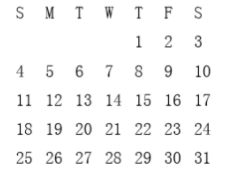
(打印月历)输入月份 m(1≤m≤12),按一定格式打印 2015 第 m 月的月历。
例如,2015 年一月的月历打印效果如下(第一列为周日):
#include<iostream>
using namespace std;
const int dayNum[]={-1,31,28,31,30,31,30,31,31,30,31,30,31};
int m, offset, i;
int main()
{
    cin >> m;
    cout <<"S	M	T	W	T	F	S"<<endl;//'	'为tab制表符
    ①;
    for (i = 1; i < m; i++)
        offset = ②;
    for (i = 0; i < offset; i++)
        cout <<'	';
    for (i = 1; i <= ③;i++)
    {
        cout << ④;
        if(i==dayNum[m]||⑤==0)
            cout << endl;
        else
            cout << '	';
    }
    return 0;
}(中位数)给定 n(n 为奇数且小于1000)个整数,整数的范围在0~m(0
#include <iostream>
using namespace std;
const int MAXN = 1000;
int n,i,lbound,rbound,mid,m,count;
int x[MAXN];
int main()
{
    cin >> n >> m;
    for(i = 0; i < n; i++)
        cin >> x[i];
    lbound = 0;rbound = m;
    while(①) {
        mid=(lbound+rbound)/2;
        ②;
        for(i = 0; i < n; i++)
        {
            if(③)
                ④;
        }
        if(count > n/2)
            lbound = mid + 1;
        else
            ⑤;
    }
    cout << rbound << endl;
    return 0;
}在 1 和 2015 之间(包括 1 和 2015 在内)不能被 4、5、6 三个数任意一个数整除的数有_____个。
结点数为 5 的不同形态的二叉树一共有_____种。(结点数为 2 的二叉树一共有 2 种:一种是根结点和左儿子,另一种是根结点和右儿子。)
#include <iostream>
using namespace std;

struct point{
    int x;
    int y;
};

int main()
{
    struct EX{
        int a;
        int b;
        point c;
    }e;
    e.a=1;
    e.b=2;
    e.c.x=e.a+e.b;
    e.c.y=e.a*e.b;
    cout<<e.c.x<<','<<e.c.y<<endl;
    return 0;
}
输出:( )
#include <iostream>
using namespace std;

void fun(char *a,char *b)
{
    a=b;
    (*a)++;
}

int main()
{
    char c1,c2,*p1,*p2;
    c1='A';
    c2='a';
    p1=&c1;
    p2=&c2;
    fun(p1,p2);
    cout<<c1<<c2<<endl;
    return 0;
}
输出:( )
#include <iostream>
using namespace std;
int main()
{
    int len,maxlen;
    string s,ss;
    maxlen=0;
    do
    {
        cin>>ss;
        len=ss.length();
        if(ss[0]=='#')break;
        if(len>maxlen)
        {
            s=ss;
            maxlen=len;
        }
    }while(true);
    cout<<s<<endl;
    return 0;
}
输入:
I
am
a
citizen
of
China
#
输出:( )
#include <iostream>
using namespace std;

int fun(int n,int fromPos,int toPos)
{
    int t,tot;
    if(n==0)return 0;
    for(t=1;t<=3;t++)
        if(t!=fromPos && t != toPos)break;
    tot=0;
    tot+=fun(n-1,fromPos,t);
    tot++;
    tot+=fun(n-1,t,toPos);
    return tot;
}
int main()
{
    int n;
    cin>>n;
    cout<<fun(n,1,3)<<endl;
    return 0;
}
输入:5
输出:( )
(双子序列最大和)给定一个长度为n(3≤n≤1000) 的整数序列,要求从中选出两个连续子序列,使得这两个连续子序列的序列和之和最大,最终只需输出这个最大和。一个连续子序列的序列和为该连续子序列中所有数之和。要求:每个连续子序列长度至少为 1,且两个连续子序列之间至少间隔 1 个数。
#include <iostrea m>
using namespace std;
const int MAXN = 1000;
int n, i, ans, sum;
int x[MAXN];
int lmax[MAXN];
// lmax[i] 为仅含 x[i] 及 x[i] 左侧整数的连续子序列的序列和中,最大的序列和
int rmax[MAXN];
// rmax[i] 为仅含 x[i] 及 x[i] 右侧整数的连续子序列的序列和中,最大的序列和

int main() {
    cin >> n;
    for (i = 0; i < n; i++) cin >> x[i];
    lmax[0] = x[0] ;
    for (i = 1; i < n; i++)
        if (lmax[i - 1] <= 0)
            lmax[i] = x[i];
        else
            lmax[i] = lmax[i - 1] + x[i];
    for (i = 1; i < n; i++)
        if (lmax[i] < lmax[i - 1])
            lmax[i] = lmax[i - 1];
    ①;
    for (i = n - 2; i >= 0; i --)
        if (rmax[i + 1] <= 0)
            ②;
        else
            ③;
    for (i = n - 2; i >= 0; i --)
        if (rmax[i] < rmax[i + 1])
            ④;
    ans = x[ 0] + x [2];
    for (i = 1; i < n - 1; i++) {
        sum = ⑤;
        if (sum > ans)
            ans = sum;
    }
    cout << ans << endl;
    return 0;
}